Examples of Reading Conferences Teaching Points for First Grade Students
You might already know that a reading conference is one-on-one reading didactics. Just how practise yous comport a reading briefing? And are they really worth the time they take?
Every school solar day is packed, and it seems as if in that location's never enough time to "fit it all in." I experience like reading conferences are one of the beginning things that get eliminated from the literacy cake!
Simply they are so valuable! In today'south post, I'll share with y'all WHY reading conferences are important and explain HOW to conduct them!
Why i-on-1 reading conferences?
When I kickoff began teaching, I didn't brand fourth dimension for one-on-one reading conferences.
I taught guided reading groups and gave my students as much individual attention as I could. But I'd gear up up my literacy block and so that students read independently as a center, and so I was occupied teaching guided reading during that time. With this setup, I reallycouldn't conduct reading conferences.
However, I quickly realized how important it was for me to cheque in with students while they read independently. Conducting reading conferences allows me to:
- Meet what books students are choosing to read independently (and help them adjust the level, if necessary)
- Determine if students are actually applying what they are learning during other parts of the literacy block (it makes no sense to teach, teach, and teach and so non see if they are applying the skills to where it really matters—independent reading!)
- Spend precious one-on-1 time with my students (this helps build our relationship and also allows me to provide super-targeted, relevant didactics to each reader)
If y'all're all the same non convinced, consider this metaphor:
Let's say that your motorcar has an engine problem. You take the auto into the shop, and the mechanics practice their best to ready it. But they don't test-drive the car to see if the problem is solved. You pick upwardly the car, bold that the problem is solved, but you lot drive half a block and it breaks downwards again! ??♀️
In this metaphor, your reading instruction = the mechanics trying to fix the problem. Reading conferences = exam-driving the car.
You wouldn't want your mechanic to attempt to fix the problem and just hope for the best. Similarly, nosotros shouldn't teach, teach, teach and promise for the best without checking to see if our students are actually using what they acquire when they read independently!
Now, I always set aside daily time for students to read independently while I acquit equally many reading conferences equally time allows. I may not become through very many conferences in 1 day, merely I'thou at to the lowest degree makingsome time for this super-important practice.
What "should" a reading conference await like?
I put "should" in quotation marks above because there's no ane right style to conduct conferences!
Generally speaking, a reading conference is about 5 minutes long, involves the teacher and ane educatee, and is designed to target students' private needs. In a reading conference, the footing for the discussion / instruction is a book that the CHILD has selected to read.
I don't have a set number of conferences that I behave per day or week (although I do effort to run into all of my students once every ii weeks). The number of conferences that you comport each day will depend on a) your daily schedule and b) the frequency with which you see students in guided reading / minor groups. (If you only see students in pocket-size groups nigh in one case a week, and so you volition want to program for more than individual reading conferences than if, say, you see students 3-4 times per week for guided reading.)
I tend to teach 3 different types of reading conferences: standard, check-back, and extended conferences. In the next sections, I'll explain what each 1 of these conferences looks like.
Standard Conferences
In a "standard" conference, I follow the notice-compliment-teach routine. This is not something I made upward; many teachers use this method, and I believe I first learned near it in Jennifer Serravallo and Gravity Goldberg'southward 2007 bookConferring with Readers. In an observe-compliment-teach conference, I run into how the student is doing, provide a compliment about something she is doing well, and teach or review i strategy to help her movement forwards.
For me, a successful conference begins earlier I ever sit down with the reader. I have to have, in my heed, some general ideas about what I might want to piece of work on during the briefing. Otherwise, 1 of ii things might happen:
- I go bare and am non sure what to teach during the final part of the conference
- I detect something that I could teach, and I teach the strategy—just it'southward non a "high priority" strategy (meaning, it's not related to our current reading workshop unit or an important skill for the student to master at his/her electric current reading level)
To avoid this, I always try to have these 2 things with me during ANY conference:
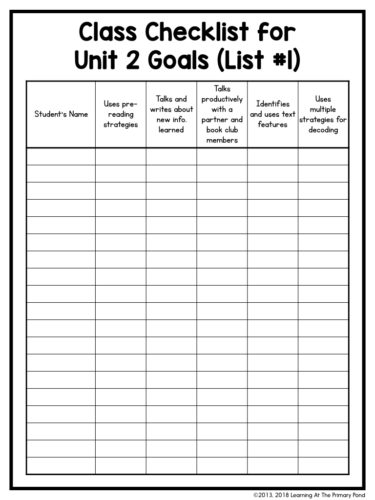
- A list of goals for our electric current reading unit of measurement
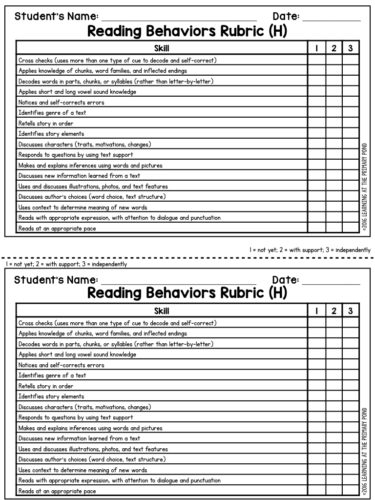
- A list of strategies that are relevant to the student's electric current reading level (since I accept readers at many levels, I take many checklists with me and only turn to the correct one for each student)
Here are examples of both (the "form checklist" is from a second form reading unit and has one boosted page, not shown; the Level H rubric is an example of a reading level specific strategy list):
Beingness prepared for a briefing is essential and helps me get the most "bang for my buck!" When it'south fourth dimension to conduct the briefing itself, here's what that looks like:
Observe
- I bank check in to see how this reader is doing. I want to observe at to the lowest degree one thing to compliment him/her on, and one thing to teach to move the reader forwards.
- I usually do one of the post-obit things during the observation component: ask the reader what strategy he/she is working on, ask a focused question to help me observe out something specific ("Why did you choose this book?" or "What do you like about this book?"), ask the reader to depict what is happening in the text (comprehension check), or ask the reader to read a department of the text out loud to me.
- I endeavor to jot down at least one thing I see the pupil doing well and one expanse for improvement.
Compliment
- I tell the reader what I noticed her doing, using very specific linguistic communication. (Example: "I saw that you covered up the terminate of that give-and-take with your finger. Yous read the base discussion, uncovered the ending, and read both parts together. That was a great strategy for figuring out a longer word!")
- I encourage her to keep doing it!
Teach
- I teach the reader one new strategy that I believe could help move her frontwards, OR I review something that we have worked on in the past.
- This instruction point is usually related to one of my goals lists that I mentioned before – the unit-specific checklist, or the reading level specific checklist).
- To demonstrate the strategy, I choose a unlike give-and-take or section in the text she is reading OR I use a text that I brought to the conference for modeling purposes (y'all can read a little more than about that strategy Here).
- If possible, I inquire the student to demonstrate the strategy correct there and then (this can usually be done hands with decoding or fluency strategies), OR to write on a sticky note the next time she uses the strategy (amend for comprehension or vocabulary strategies).
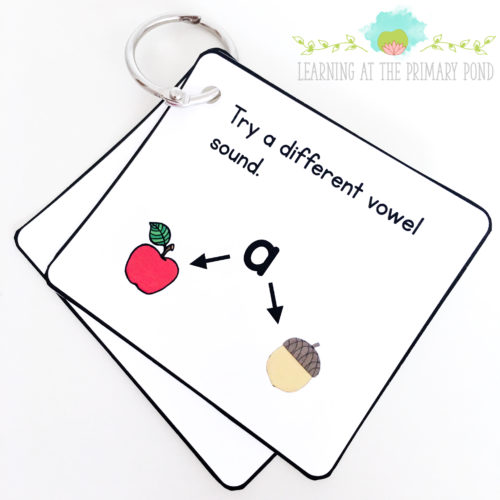
- I provide a visual reminder to assistance the student remember to use the strategy (I like to use these strategy cards from my reading workshop toolkits, shown below)
- I thank the reader for conferring with me and wrap up the briefing!
All of this happens in about v minutes, which can make timing tricky!! Use a timer if you're having trouble keeping your conferences brief. 🙂
Check-Back Conferences
A check-back conference is slightly different and does not follow this observe-compliment-teach routine. In a check-back conference, I'thousand touching base with a student to see if she has been using a strategy I taught previously.
The structure of this type of briefing is a little "looser." I might begin by:
- Asking the child to read aloud from his book
- Inquiring direct virtually the strategy: "Tin you evidence me an case in this volume or some other one where y'all <made a prediction / insert your own strategy hither>?"
Once I've determined whether or not the child is using the strategy, I then:
- Praise the child for using it (if applicable)
- Re-teach the strategy in a different way (if necessary)
- Provide a visual reminder to employ the strategy (if I haven't already)
- Encourage the child to continue using the strategy
In my own notes, I record my observations about if/how the child is using the strategy (or not using it yet).
Extended Conferences
An extended conference is….just what it sounds similar. 🙂 A longer conference!
I rarely use extended conferences. Merely if I've noticed that a child is REALLY struggling with one attribute of reading, and guided reading / regular conferences aren't helping, I know that I have to devote a picayune more time to helping him/her.
In an extended conference, I basically eliminate the "Observe" portion of the "Observe-Compliment-Teach" routine. (It's unnecessary; I already know what I want to piece of work on!)
I begin by giving the child a compliment about his / her reading. Then, I spend five-10 minutes working with the child on the "trouble spot." I comprise modeling, guided do, and and so encourage the child to continue using the strategy independently.
When I behave an extended conference, I usually follow information technology up with a "check-back" conference a few days later. Since I devoted extra time to that educatee, I desire to make sure that he/she is following through with the strategy!
More than Aid with Reading Workshop
For more assist with reading workshop, take a peek at my new shared reading units for Kinder, 1st, or 2nd grade. You can acquire near them Hither!
Happy pedagogy!
Source: https://learningattheprimarypond.com/blog/how-to-conduct-individual-reading-conferences-kindergarten-first-second-grade/
0 Response to "Examples of Reading Conferences Teaching Points for First Grade Students"
Post a Comment